This is a free crochet pattern and video tutorial showing how to crochet the Shay Washcloths, which is an easy crochet project worked in simple single crochet stitches, and available in 3 sizes.
Find the free crochet pattern instructions below, or purchase a printer-friendly, ad-free PDF on Ravelry by clicking here.
This post contains affiliate links. If you make a purchase by clicking on them, I make a small commission at no extra cost to you. I only recommend products I love and hope you’ll love them too! Click here to find out about the different affiliate programs I am apart of. This post also contains shop links to my yarn shop and craft store, Yarn Crafts & Coffee. You can shop online or in person in Melbourne, Florida.
In a hurry? Pin this for later when you have more time.

Handmade washcloths are great for washing dishes with, and also feel fantastic against the skin in the shower.
My Shay series is an easy crochet line that features simple single crochets. You can find more accessories in this series on my sister blog, Cre8tion Crochet.
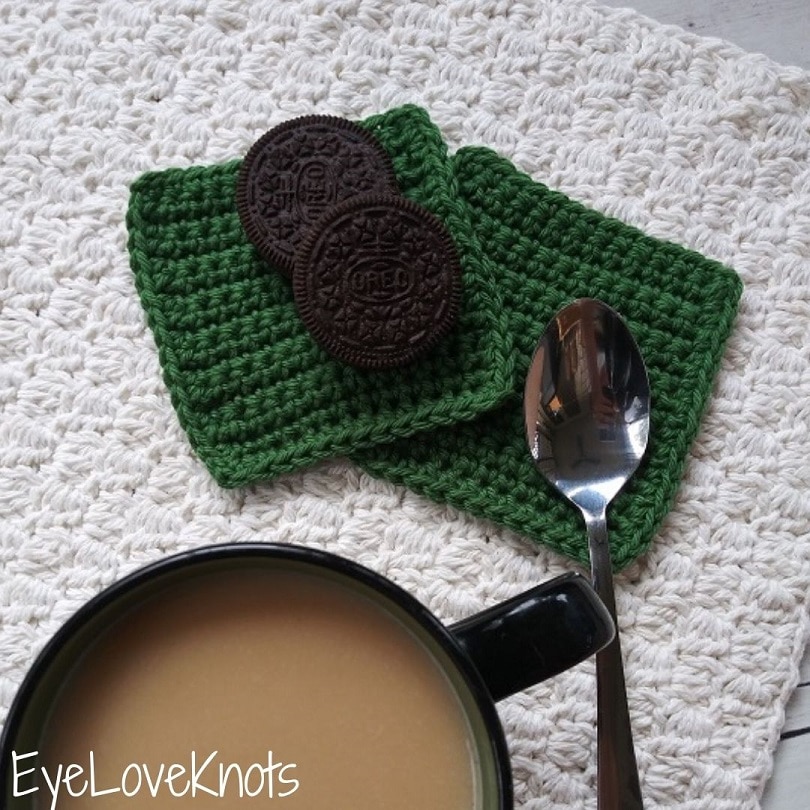
If you’re looking for a gift, work up a set of three, and wrap with a bow, or place in a spa or kitchen themed gift basket with some Shay Coasters – they are perfect for cups, as mini washcloths and large facial scrubbies.

Where Do You Use a Washcloth?
Washcloths, sometimes called a washrag, are just a miniature bath towel, and designed to be absorbent, soft and easy to use being hand held. Washcloths can be used as a small hand towel to dry off after washing hands, as well as in the shower with soap to clean and exfoliate. Crocheted cotton washcloths feel amazing against the skin, and are better for you than loofahs, as loofahs can harbor bacteria more.
How Often Should I Clean and Change a Washcloth?
For hand drying, a washcloth should be washed about once a week.
For use in the shower, I’ve heard a washcloth should be changed out a couple times a week for washing with good rinsing between uses to get rid of as many dead skin cells and bacteria as possible, but a washcloth should really be used once, and than washed as it harbors bacteria, and possible mold growth is it doesn’t dry out properly, and can hold onto debris.
How Do I Dry a Crocheted Washcloth?
After using, rinse the washcloth to remove as much debris and bacteria as possible, roll up and press excess water out (do not wring out a crocheted washcloth), and lay flat to dry. It’s not recommended to hang crocheted washcloths as they can stretch, especially if wet because they’re heavier.
What is the difference between a Crocheted Washcloth and Dishcloth?
A crocheted washcloth and a dishcloth are practically one in the same with the biggest difference being how you use it.
Ad-Free, Printer Friendly PDF:
From 10/21/26 midnight EST through 10/25/26 at 11:59pm EST, you can grab a free copy of the PDF for the Shay Washcloths on Ravelry using code CLEAN26. I earn my income from the number of pageviews my blog sees, so please do not share the code, but instead share the link to this post so others can find it. Thank you!
After 10/25/26 or for non-subscribers, if you would like a PDF version of this post, you may get one through either my Etsy Shop or Ravelry Shop for a small fee. This fee is to compensate for the views lost when you no longer need to return to the blog to for the information, as you will have your own copy. Plus! It helps fund supplies for new projects to share with you!
In a hurry? Pin this for later when you have more time.
Save this to Your Favorites On: AllFreeCrochet, FaveCrafts, Crochet Pattern Bonanza, Cheap Thrifty Living, DIYideaCenter, AllFreeHolidayCrafts
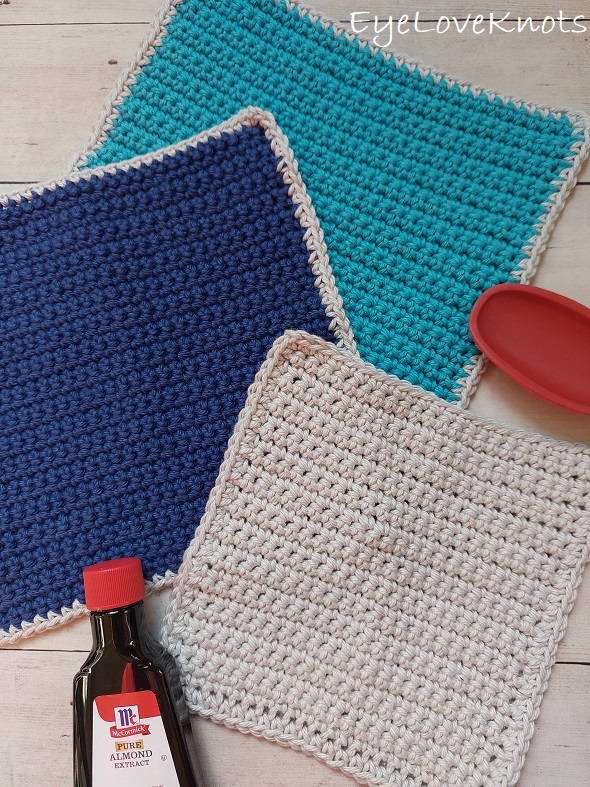
What Supplies Do I Need to Crochet Some Washcloths:
- 45 (60, 75, 90) Yards of Worsted Weight Cotton Yarn
- H8/5mm Crochet Hook
- Tapestry Needle
- Scissors
- Optional, Jewelry Pliers
Material Notes:
I used WeCrochet Dishie in the Clarity, Azure and Blue colorways. Aside from this yarn, my favorite cotton yarns are Cascade Nifty Cotton and Queensland Coastal Cotton because they’re colorfast, which means the colors are set so you don’t have to worry about the colors fading or bleeding with use. My experience with Lily Sugar n Cream, Bernat Handicrafter and Crafters Secret Cotton is that with one wash, the colors fade a lot, and some colors, like greens and blues, bleed if laid down on a surface while wet. It’s so disheartening to spend so much time crocheting a project only to have it ruined with one wash. I’ve heard that I Love This Cotton Yarn is also colorfast, and seems to be the choice for many crocheters that do markets as it’s also softer.
WeCrochet Dishie (aka Knit Picks Dishie) is a versatile, soft worsted weight #4 yarn made of 100% cotton. It’s on the lighter side for worsted weight working up similarly to Cascade Nifty Cotton, Queensland Coastal Cotton and I Love This Cotton from Hobby Lobby. It’s machine washable and dryable making projects easy to care for. As of June 1st of 2026, it is available in an amazing number of colors – 83 colors.
Cascade Nifty Cotton Yarn is a versatile, soft worsted weight #4 yarn made of 100% cotton. It’s on the lighter side for worsted weight working up similarly to WeCrochet Dishie, Queensland Coastal Cotton and and I Love This Cotton from Hobby Lobby. It’s machine washable and dryable making projects easy to care for. As of June 1st, it is available in an amazing number of colors – 66 colors.
Queensland Coastal Cotton is a versatile, soft worsted weight #4 yarn made of 100% cotton. It’s on the lighter side for worsted weight working up similarly to Cascade Nifty Cotton, WeCrochet / Knit Picks Dishie and I Love This Cotton from Hobby Lobby. It’s machine washable and dryable making projects easy to care for and it’s colorfast. As of June 1st, it is available in an amazing number of colors – 64 solid colors and 39 variegated colors – as well as in Sport Weight #2.
Cotton yarns are used the most and are very durable for repeated use and washing and while a 100% non-mercerized cotton is my number one recommendation, there are a few other great options as well.
Linen also makes for lovely washcloths. It gets strong when wet, and gets softer and nicer with each wash. Linen blends often combine with cotton or bamboo to add softness.
Due to the shedding of microplastics, cottons blended with a synthetic fiber are not a popular choice for washcloths. While combining a synthetic fiber, such as acrylic or polyester adds more durability, these fibers do lack the absorbency and will repel water, which can lead to skin irritation. If you choose to use a cotton blended with a synthetic fiber, lean towards one with a high cotton percentage to balance it out.
Bamboo yarns have a high absorbency – even more than cotton – however, bamboo is weaker when wet, and more prone to developing mold so if bamboo is a fiber you want to use, I definitely recommend going with a blend of linen and/or cotton.
Mercerized cotton yarns under go a chemical process, involving soda ash, to give them a smooth and shiny appearance and make them a stronger, rougher fiber. Though soda ash is washed out of the yarn, I do not like the idea of using mercer- ized yarns in projects that I will use to clean with or put food on top of. The process of mercerizing yarn also takes away the absorbency that non-mercerized cotton has. While it will still absorb water, it does it at a much slower rate and less than a non-mercerized cotton would. While mercerized cotton yarns are great for many crochet projects, they are not yarns I reach for when making washcloths.
Tools & Notions:
We have lots of great crochet hooks in our Yarn Crafts and Coffee Yarn Shop. The most popular, and preferred by Candace and Emily, are the Clover Amour Crochet Hooks with the soft handles and smooth metal hook. Alexandra prefers metal crochet hooks with large, ergonomic clay handles and just loves the fun designs from SiennasBowtique and BronzeShepherdStudio! If your preference is wood, the LYKKE brand are lovely, smooth and sturdy.
Tapestry Needles with the blunt, round end are essential for sewing and finishing on a number of yarn crafts, including crocheting, knitting as well as needlepointing on fabric and plastic canvas. The blunt, rounded end allows the needle to pass easily through the fabric created by yarn and holes on canvas without snagging (or getting your fingers) in the process. More specifically for crocheting and knitting, a Bent Tip Tapestry Needle makes weaving, grafting and sewing so much easier on the hands. The long oval eye makes threading strands of yarn easier, though you may still want to use a needle threader.
Scissors are an essential tool. When I’m working on the go, I like to carry a pair of folding scissors as they fit perfectly in even the tiniest of bags. When I am working at home or have more space in my bag for a larger notions pouch, I like to use a pair of lightweight, all-purpose scissors as they are so versatile and great for a variety of things from cutting plastic canvas mesh to trimming yarn ends after weaving in to cutting out a care card to include with a handmade gift.
I usually recommend jewelry pliers to use to help weave in ends, as cotton yarn can be quite tough on the fingers when weaving in with just fingers and a tapestry needle. Dishie Yarn is really smooth, and easy to weave the yarn in and out of.
How Long Does it Take to Crochet Washcloths:
The small washcloth works up in about 45 minutes, the medium in just over 45 minutes, the large in just over an hour, and the large long in about an hour and a half.

Measurements:
- Small: 6 1/8″ Square
- Medium: 7″ Square
- Large: 8″ Square
- Large Long: 8″ x 10 1/4″
Gauge (Not Essential):
16 SC = 4 1/8″ by 8 Rows = 2”
Abbreviation (US Term):
- SC – Single Crochet (Photo Tutorial)
Pattern Notes:
Beginning chain 1 does not count as a stitch.
There is no stitch multiple, so feel free to adjust the number of chains by any number, or add or take away rows to make the washcloth shorter or taller.
Shay Washcloth Video Tutorial:
Shay Washcloth Crochet Pattern:
Chain 23 (27, 31, 31). SC into the 2nd chain from the hook, and each chain across. [22 (26, 30, 30) SC]
R2 – 26 (30, 34, 44): Chain 1, turn. SC into the 1st SC, and each SC across. [22 (26, 30, 30) SC]
Border Notes:
The border is optional, but I like to work one to give a more finished look.
I am working a simple single crochet round, but you can change that stitch up to any that you like, or add additional rounds to the border.
As written, my corners will be more of a rounded corner. Another way you can do this is 3 SCs into the same stitch. For a more square corner, you can work a (SC, chain 2, SC) or (SC, HDC, SC) into the same stitch.
I finished my washcloths with a slip stitch join, but you could also finish your washcloth with an invisible join, which creates a clean, consistent look. Either way, this stitch will count as the final stitch for the border.
If you experience ruffling when working the border, this is caused from a change, especially seen on the sides. My quick fix is to simply go down a hook size to an G6/4.25mm. You can not change hook sizes and just block the finished washcloth.
For a photo tutorial of adding the hanging loop, please see my Haylee Washcloth written pattern or video tutorial.
Border Without a Hanging Loop:
Chain 1 (does not count as a stitch), turn. SC into the 1st 21 (25, 29, 29) SC, (SC, chain 1, SC) into the next SC, SC (that’s one SC per row) down 25 (29, 33, 43) stitches, (SC, chain 1, SC) into the next stitch, SC 20 (24, 28, 28) across the opposite side of the foundation chain, (SC, chain 1, SC) into the next stitch, SC (that’s one SC per row) up 25 (29, 33, 43) stitches, SC into the same stitch as the 1st, then join to the 1st SC. [98 (114, 130, 142) SC]. Fasten off, and weave in the ends.
Border With a Hanging Loop:
Chain 6, then slip stitch join to the last SC of the cloth to form a ring. Chain 1 (does not count as a stitch), turn. Work 10 SC into the ring. Skip the first stitch that slip stitch was made in. SC into the 2nd stitch, and each remaining stitch across over to the last stitch, (SC, chain 1, SC) into the last stitch to form a corner, evenly SC (that’s one SC per row) down 25 (29, 33, 43) stitches, (SC, chain 1, SC) into the next stitch, SC 20 (24, 28, 28) across the opposite side of the foundation chain, (SC, chain 1, SC) into the next stitch, evenly SC up the side of the cloth skipping the very last stitch on the side, then slip stitch join to the 1st SC worked into the hanging loop (which takes the place of the last stitch). [98 (114, 130, 142) SC]. Fasten off, and weave in the ends.

Please feel free to make and sell your own items made using this pattern, but keep in mind, this written pattern and my photos are protected by copyright. Please DO NOT claim this pattern as your own nor should you sell my pattern. DO NOT re-publish my photos as your own. DO NOT copy and paste my pattern anywhere, link to it instead so other’s can visit. Making videos providing instructions how to make my projects on any social media platform is also not permitted.
Join one of our awesome Facebook groups to share your creations, and see what others are up to!
– Yarn Crafts & Coffee Community
– DIY Home On Rockwood Lane
– Alexandra Lane Lifestyle
Linked Up To…
Beautifully Made Home Decor Link Party 247 – Across the Blvd
All About Home #180 – Common Ground
Home Imagined Link Party #10 – Decorative Inspirations
Tuesday Turn About #186 – My Wee Abode
Farmhouse Friday 284 – County Road 407
Home Matters Linky Party #414 – Modern on Monticello
Sundays on Silverado #129 – The House on Silverado
Handmade Monday #311 – Sum of their Stories
The Really Crafty Link Party #349 – Keeping it Real
Craftastic Monday – Sew Can Do
Happiness is Homemade – Decor Craft Design
You’re the Star Blog Hop – Decor Craft Design
Hello Monday – Pink Lady
Anything Goes Linky 362 – My Random Musings
Fabulous Party 460 – Lou Lou Girls
Talent Sharing Link Up – Scribbling Boomer
The Happy Now Blog Link Up #357 – JENerally Informed
Linky Ladies Party #232 – The Purple Poncho
The Wedesday Link Party 487 – Oombawka Design Crochet
The Loop Scoop 54 – Moogly Blog
Wednesday Link Party #332 – Grandma’s House We Go
Wonderful Wednesday Blog Hop – My Life Abundant
Team Creative Crafts Link Party #130 – Artsy-Fartsy Mama
Thursday Favorite Things #576 – An Artful Mom
Creatively Crafty Link Party #364 – Try It – Like It – Create It
Encouraging Hearts and Home Blog Hop – My Slices of Life
Grace at Home No. 493 – Imparting Grace
Crafty Creators Link Party #53 – Life as a LEO Wife
Create, Bake, Grow & Gather Party #556 – Shabby Art Boutique
Funtastic Friday Link Party #421 – Simply Beautiful by Angela
A Morning Cup of Joe – The Cottage Market
Saturday Sparks Link Party 550 – Pieces Pastimes
Pink Saturday – How Sweet the Sound
One More Row – Free Crochet Link Party #51 – Loops and Love Crochet
Share Your Crafts Link Party #2 – White House Crafts
I am a huge fan of a handmade crochet dishcloth, ever since making some last year I’d never go back to shop bought ones. They are the best. These look easy to make and very practical.
I must agree! I quite like them too 🙂 And I like the red ones you made too!
Thank you for the detailed information and tutorial to make these washcloths. These would make lovely gifts for friends. Thank you for sharing this post in the Talent-Sharing Tuesdays Link-Up 50.
Carol
http://www.scribblingboomer.com
They definitely would!
Love the colors! thanks for sharing on craft schooling sunday great to reconnect at last!
Indeed! I’m glad you’re back 🙂